Visualization
Visualize the association between two continuous variables over time using lineplot
This line plot is useful when you have two continuos variables that are correlated to each other the association is a function of time. Particularly, I used this plot to visualize the dynamics in the association between the integrated gradient of a biomarker (TSH) to the target variable (LDL) accross several doctor visits in the DPV project.
First we need to load necessary R libraries.
        library(dplyr)
        library(ggplot2)
        library(RColorBrewer)
After finetuning the LLM, I extracted the integrated gradients of all the parameters to evaluate the feature importance. The input for the plot is a 500x50 matrix of gradient values of the biomarker for 500 samples and 50 timepoints.
Lineplot
Here I modify the input and make the plot:
        # Color scale for the biomarker
        col_fun <- colorRamp2(c(-2.5, 0, 6.5), c("deepskyblue4", "white", "coral4"))

        # Modify the matrix
        colnames(tsh) <- paste0("Visit",1:49) # 49 visits
        tsh <- pivot_longer(tsh, everything(), names_to = "Time", values_to = "Gradient")
        tsh$Time <- factor(tsh$Time, levels = paste0("Visit",1:49))
        tsh$Sample <- rep(paste0(1:500), each = 49) # 500 samples
        tsh$LDL <- rep(ldl, each = 49)

        # Apply the custom color function
        tsh$Color <- col_fun(tsh$LDL)

        # Plotting
        ggplot(tsh, aes(x = Time, y = Gradient, group = LDL, color = Color)) +
            geom_line(alpha = 0.8) +
            scale_color_identity() +  # Use the exact colors provided by col_fun
            theme_minimal() +
            theme(axis.text.x = element_text(angle = 45))
And here is the result:
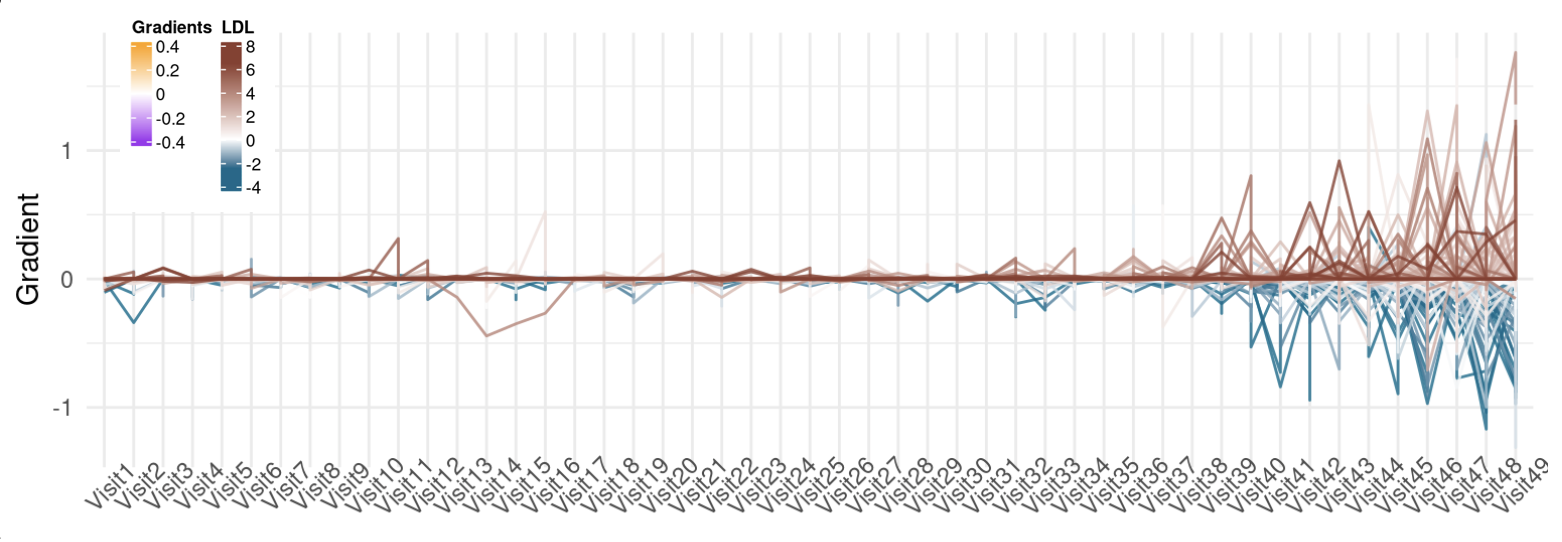
Assopciation between TSH's gradient and LDL overtime.